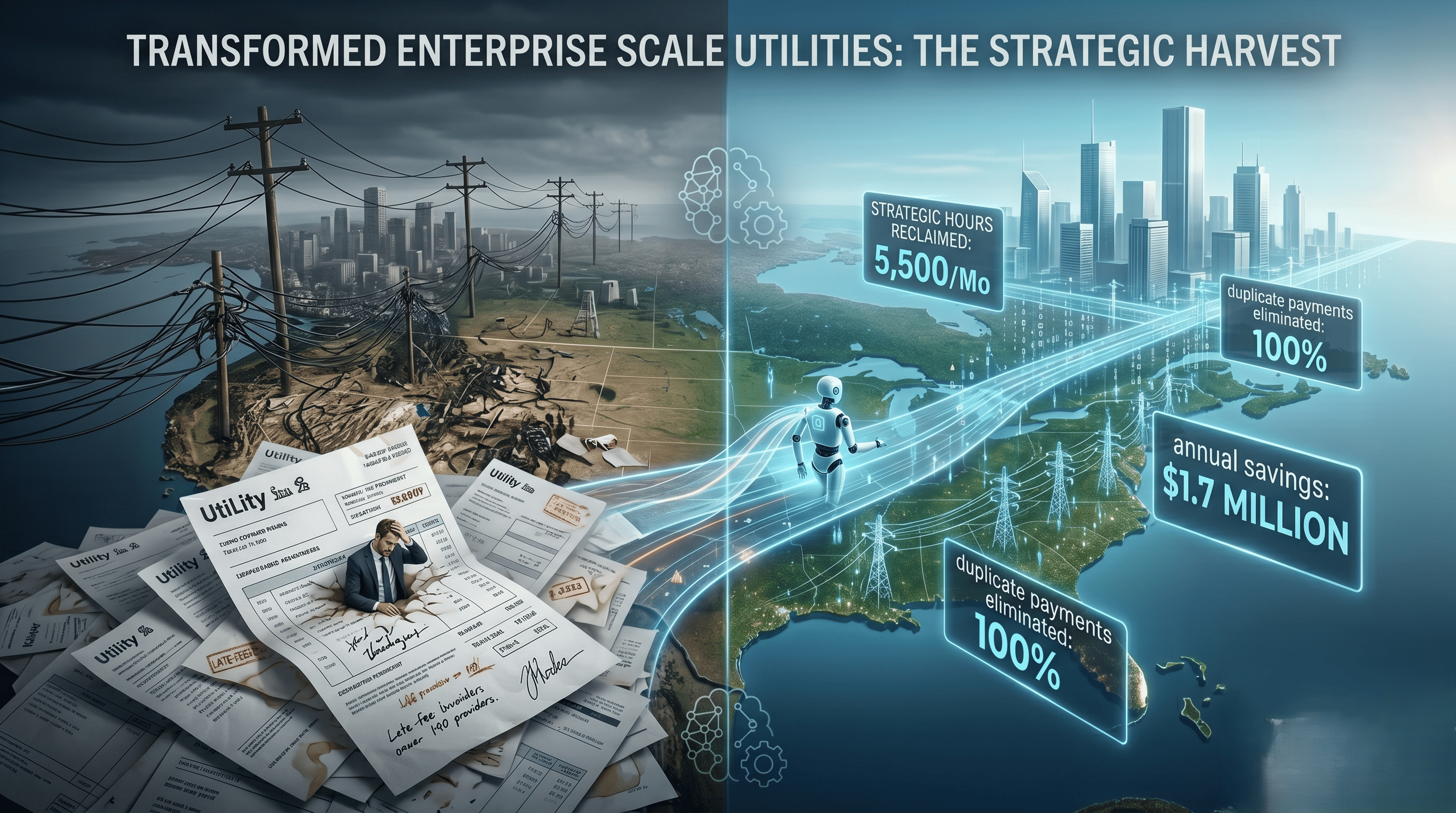
The Reality of Enterprise Scale Utilities
Phase 1- Process Discovery and Opportunity Assessment
As the lead Automation Business Analyst for this project, my work began long before any code was written. I sat down with the finance directors and the frontline data entry teams to map their As Is process. Listening to their daily struggles was crucial for a proper opportunity assessment. We discovered that the sheer volume of web portals made it incredibly difficult to keep up with varying billing cycles. Worse, the invoices arrived in highly variable formats. Some providers offered clean digital documents. Others provided scanned images of handwritten documents where a field technician had simply scribbled a total amount due. It was a chaotic environment, but it was the perfect candidate for enterprise automation.
Phase 2- Feasibility Assessment and The Business Case
Before proposing a solution, we had to apply strict technical validation criteria. We could not just assume automation would work. We mapped all 140 web portals to understand the filtering processes required to navigate their distinct user interfaces. We also evaluated the complexity of reading those handwritten utility bills. The business case we presented to the executive stakeholders was undeniable. Automating invoice processing using UIPath would not just save endless hours of manual labor. It would reclaim lost revenue by preventing late fees and duplicate payments. We proposed a hybrid architecture combining core RPA for portal navigation and UiPath Document Understanding to conquer the unstructured data. With stakeholder responsibilities clearly defined and the Return on Investment (ROI) validated, we moved to design.
Phase 3- Process Design and The To Be Workflow
Creating the Process Design Document is about translating human actions into digital logic. I designed a robust To Be workflow structured into four precise transactional steps to ensure flawless execution.
Phase 4- User Acceptance Testing and Daily Reporting
Building the bot is only half the battle. Gaining the trust of the finance team is the other. During User Acceptance Testing, we ran the automated outputs alongside their manual work to prove the absolute accuracy of the system. Complete visibility is crucial in automated financial operations. To ensure transparency, we maintain a live tracking sheet on OneDrive. This serves as our daily reporting mechanism. It meticulously records exactly which utility invoice was downloaded, processed, and successfully sent to the client. We included dedicated comment columns so both our internal support team and the client can communicate effectively on a single invoice basis.
Detailed Execution Steps
Maxnet tackled Client’s data challenges by employing a structured, well-defined strategy involving data centralization, integration, and advanced business intelligence tools.
Data Initialization and Input Processing
Our workflow begins by having the bot securely read credential and account data directly from encrypted input sheets. The bot uses this structured data as a transactional queue. It knows exactly which utility provider to target next to ensure a flawless starting point.
Automated Portal Navigation and Authentication
The bot securely logs into the target website using the injected credentials and selects the correct client account. Thanks to our meticulous analysis of 140 interface variations our developers built highly resilient dynamic selectors. The bot navigates these diverse portals faster and far more accurately than any human could.
Automated Document Download
Once authenticated the bot successfully locates the latest billing document. It then systematically downloads the invoice to a secure central repository. Getting the document securely stored is crucial before our intelligent processing framework can safely take over and handle the complex unstructured data requirements.
Intelligent Document Processing
This is where true operational magic happens. We trained machine learning models to extract critical data from native digital files and complex handwritten documents. Using Advanced Optical Recognition and intelligent classification the system and the interprets handwritten totals and dates. It effortlessly transforms unstructured text into clean usable financial data.
Verification and Business Exception Handling
The system runs a strict validation check based on our defined business rules. It verifies if the specific invoice was previously processed to guarantee zero duplication. If the bot encounters a completely new handwriting style or a corrupted file it flags the item for quick human review.
Measurable Impact and Outcome:
Performance Gain:
- The speed and accuracy improvements were immediate and staggering. Previously, the human team took an average of twelve minutes to process a single complex utility bill. Our unattended RPA bots process that exact same document in under forty seconds. This represents an incredible 94 percent reduction in processing time. Furthermore, by utilizing our intelligent document processing framework to handle handwritten documents, we increased data accuracy from a flawed 82 percent to a near perfect 99.8 percent. The bots now effortlessly handle over 1500 invoices every single month with zero data entry errors.
Cost Optimization
- Eliminating the need for manual web scraping and data entry completely changed the financial landscape for our client. We successfully reclaimed over 700 hours of manual labor every month. Instead of hiring temporary data entry clerks during peak billing cycles, the finance department can now rely entirely on their digital workforce. This direct reduction in manual labor translates to an annual cost savings of million dollars. Additionally, the smart verification process completely eliminated duplicate payments and late fees, saving the company an additional thousands of dollars in unnecessary penalties.
Scalability
- A business case must always account for future growth. Because these unattended RPA workflows are managed on our proprietary Workflow Manager Scheduler, the system offers infinite scaling potential. Last quarter, the retail giant acquired a smaller competitor and suddenly had to integrate 40 new regional utility providers into their portfolio. In a manual world, this would require hiring and training a dozen new employees. With our UiPath solution, we simply added the new credentials to the input sheets. The system absorbed a 25 percent volume increase overnight without requiring a single new hire or causing any delay in processing.


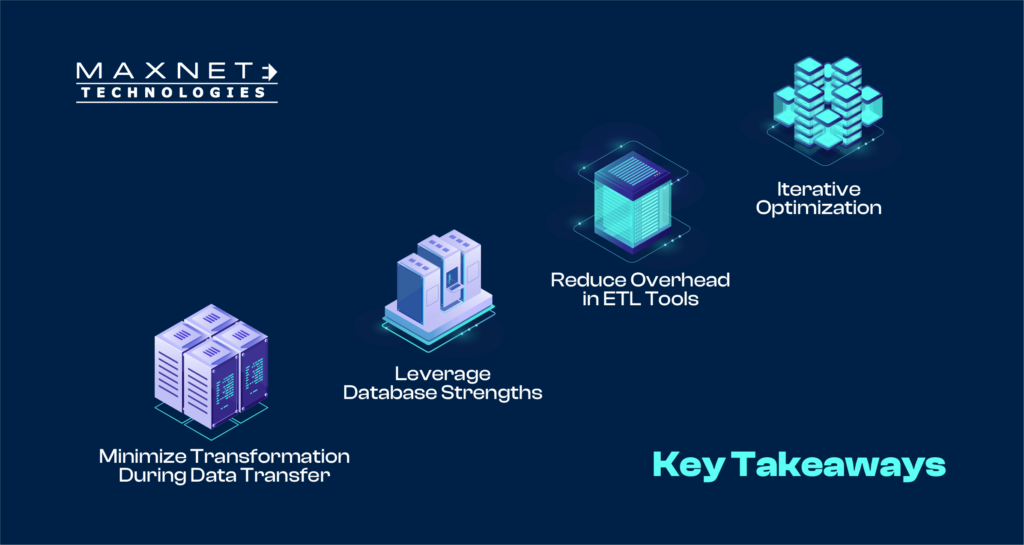
Key Takeaways
- Embrace Unattended Automation:
Focus on moving raw data as quickly as possible to the database, deferring transformations to where resources are optimized for such tasks. - Unlock Unstructured Data:
Implementing Intelligent Document Processing allows businesses to effortlessly extract actionable data from both clean PDFs and highly variable handwritten documents.
- Customized Execution Windows:
Running bots only during known document generation periods saves vital server resources and vastly improves overall system efficiency. - Continuous Stakeholder Alignment
Utilizing cloud hosted daily reporting ensures that everyone from the data entry clerk to the Chief Financial Officer always knows the exact status of their operational pipelines.
Ready to reduce your technology cost?
The implementation of RPA and Intelligent Document Processing transformed a chaotic manual burden into a streamlined, high-speed financial engine. This case study proves that automation goes beyond simple task replacement; it provides the scalability to absorb acquisitions overnight and the intelligence to conquer unstructured data.